Walking the Advent Spiral: Finding Light in Winter
Scroll to the bottom of the blog for safe and inclusive ways to share this with your child at any age/ stage of development.
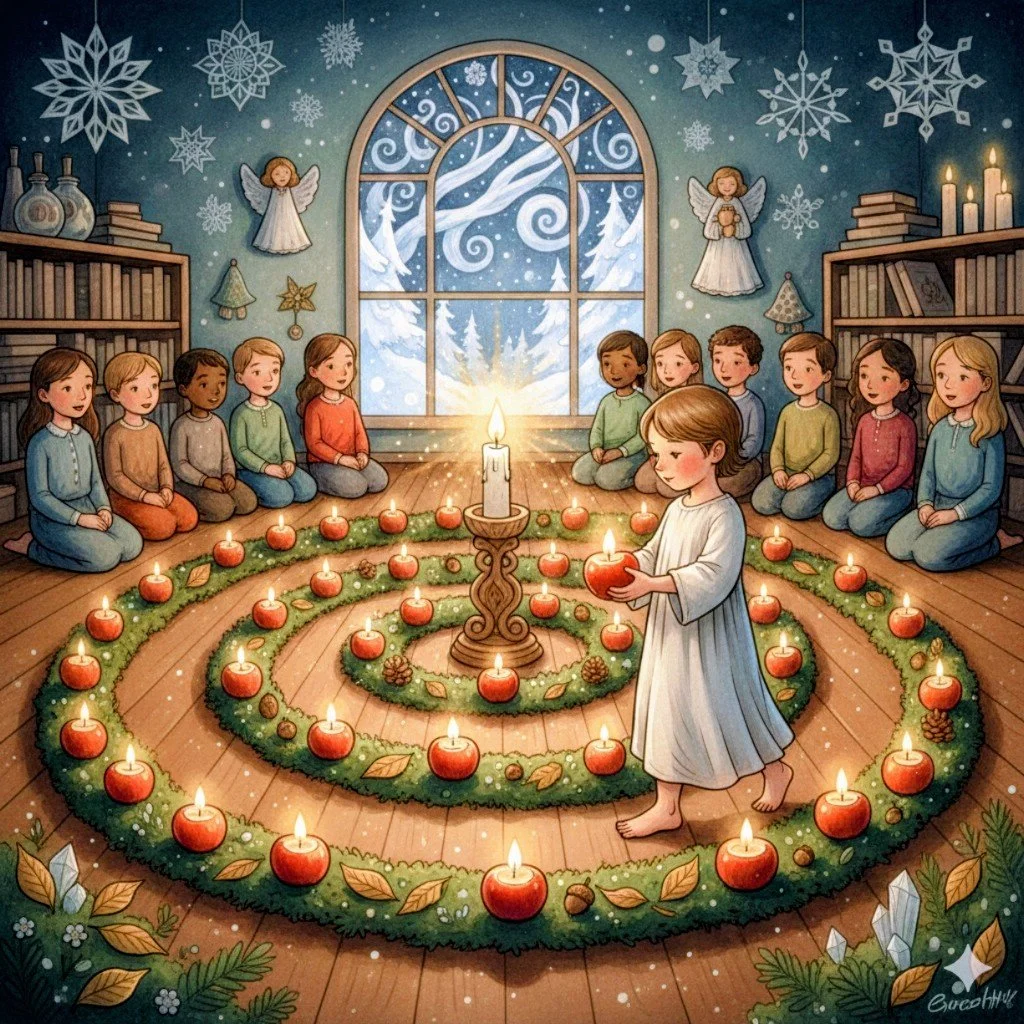
A child wearing a white gown walks the Advent Spiral holding a lit candle in an apple while their classmates watch on.
It’s nearly December, and I’m feeling that familiar mix of anticipation and overwhelm. As a neurodiverse person, I’ve always been sensitive to seasonal shifts — not just the weather, but the emotional rhythm of this time of year.
I live in Bristol, where the skies are reliably grey and the streets start to sparkle with fairy lights and frantic shoppers. And while I do love Christmas — the music, the food, the sense of togetherness — I also find myself craving something quieter. Something slower. Something that doesn’t come wrapped in plastic.
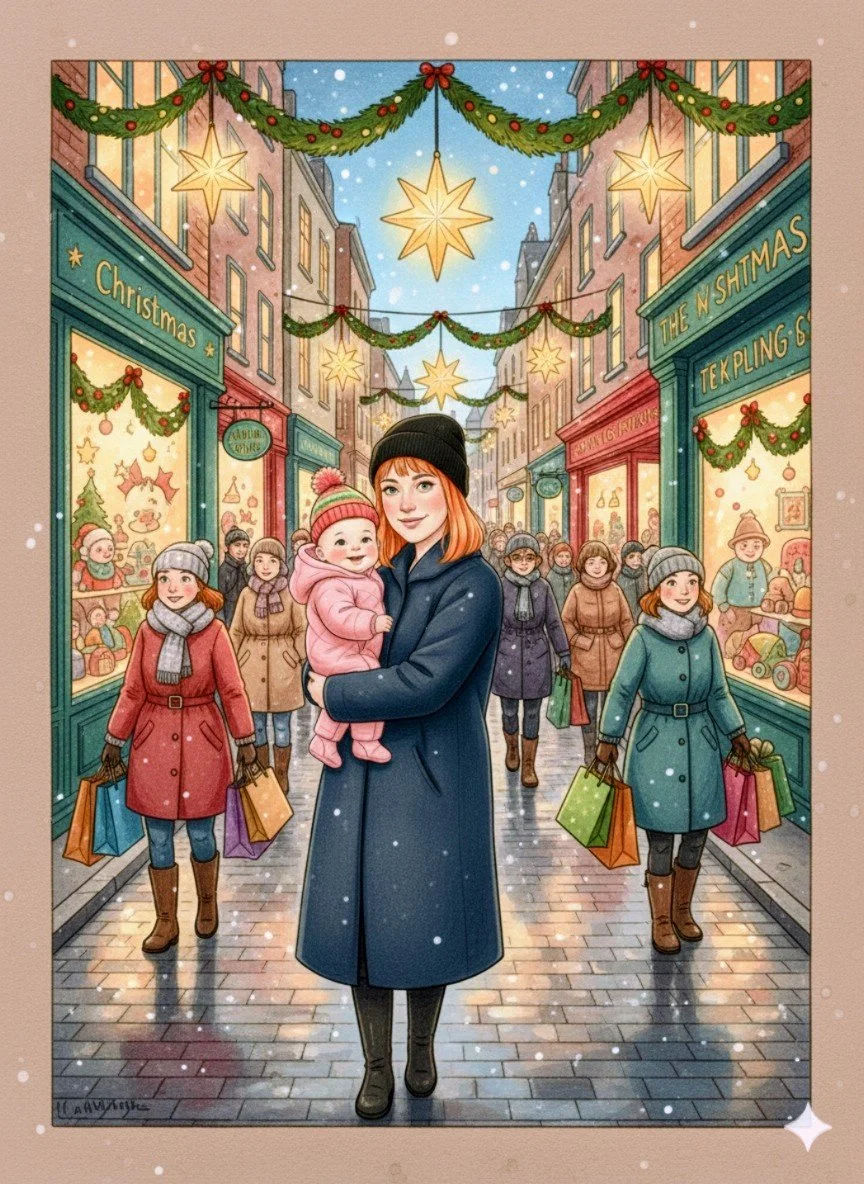
An illustration of me and my daughter braving the high street at Christmas time.
Several years ago, when I was working at a SEN school with a Steiner-inspired curriculum, the Advent Spiral was one of my favourite festive activities. It’s a simple, beautiful ritual: children walk a spiral of greenery, carrying an unlit candle. At the centre, they light it from a single flame, then place it along the path as they walk back out. Slowly, the spiral fills with light. It’s not about presents or glitter. It’s about rhythm, patience, and remembering that even in the darkest time of year, light grows when we share it.
I always thought it was such a beautiful and deeply meaningful activity. I remember standing in the hall during the Advent Spiral and watching the pupils quietly and safely walk the path, candle in hand. Each step was slow, deliberate, and full of meaning. Some pupils needed the gentle support of one or two adults walking side-by-side, but still, every year pupils chose to take part in the gathering, and the calm atmosphere would hold them in a way I had not quite seen before. I would feel immense pride in my students as they lit their candles and placed them along the spiral, the space gradually filling with light. It was a testament to the power of ceremony and repetition, and the atmosphere was nothing short of magical.
I recently listened to the audio book version of If Women Rose Rooted: A Life Changing Journey to Authenticity and Belonging, by Sharon Blackie. The book made me reflect deeply on the kind of mother I want to be, and the kind of traditions I want to root my new family in. Sharon Blackie’s call for women to reconnect with land, story, and rhythm reminded me that parenting isn’t just about meeting daily needs — it’s about creating a sense of belonging and meaning. I want my daughter to grow up with rituals that honour the seasons, with celebrations that feel grounded in nature rather than consumerism, and with stories that remind her she is part of something bigger. The book helped me see that family traditions can be simple yet powerful: lighting candles, walking spirals, gathering stones or leaves, telling stories. These small acts are how we rise rooted — and how I hope to give my daughter a childhood that is rich in connection, not possessions.
The Advent Spiral. while rooted in a specific tradition, offers a powerful and visually rich metaphor for fostering nature connection and imagination through natural resources.
Imagine a path laid out in a gentle spiral on the ground. It is often created with evergreen boughs, like fir, or pine, hinting at life and resilience even in winter. In the centre of the spiral a single candle stands lit. Along the path simple natural treasures might be placed: a smooth stone, a fallen leaf.
As the child walks the spiral, perhaps in a dim room with quiet calm music, they carry their own candle - initially unlit. The defined spiral path provides a clear yet gentle structure, it guides the journey without dictating the experience. Providing a collection of safe, natural resources offers a structured invitation to explore.
The child is gently guided by the structure to the centre to light their own candle, if safe to do so. I am going to use LED candles, and alter this process to suit the needs and understanding of my daughter. We will bring in the ceremony of the spiral, but not in strict adherence to steps. The magic is in the slow, rhythmic pace of walking together and the safe independent exploration of natural resources.
The true gold of this tradition is in the simple act of creating a quiet, intentional space. It teaches children that rhythm and ritual can be found in the every day, encouraging their natural curiosity and imaginations.
A simple Advent Spiral.
Rhythms and rituals are at their best when they serve as shared anchors, connecting us across all beliefs and backgrounds. A healthy tradition is one that is wide enough to hold everyone. It should inspire inclusion, belonging, and respect everyone’s family journey. In my family this tradition will evolve with us to meet the needs of each unique stage of my daughters development. Tomorrow, I’ll be making a soft, safe, crawl‑able version of the Advent spiral for my daughter. She’s too little to carry a candle, but she can explore the path with her hands and knees, discovering textures and light in her own way.
The Advent Spiral reminds me that we don’t need more stuff. We need more presence. More rhythm. More love. And maybe, as adults, we need those things just as much as children do.
So this Advent, I’m reminded of the message of the Advent Spiral, in dark times it is that the light we carry that matters — and that sharing our light and our kindness with others is what makes us human.
The themes of Advent Spiral
If you are interested in creating your own advent spiral. this year, Advent begins on Sunday 30 November 2025 and runs for four weeks until Christmas.
In Steiner/Waldorf tradition, each week has a theme that connects us to the wider world.
Week 1 (Nov 30 – Dec 6): Stones and minerals — honouring the foundations of the earth.
Week 2 (Dec 7 – Dec 13): Plants — recognising growth and life that springs from the soil.
Week 3 (Dec 14 – Dec 20): Animals — celebrating movement, instinct, and companionship.
Week 4 (Dec 21 – Dec 24): Human beings — reflecting on our place in creation, our light, and our responsibility.
My safe and inclusive Advent Spiral activity ideas for children:
Week by week
This is how I plan to introduce the themes to my almost one year old, with some ideas for adapting to suit different needs.
Walking the spiral: Honouring the ceremony but value connection over compliance.
Model it, if you can, go first and walk the spiral calmly.
I will walk the spiral carrying my daughter and walking slowly and rhythmically to music or singing or humming quietly holding her close.
Hold hands and walk the spiral together.
If your child enjoys counting, you could count the steps to the centre quietly.
The most important element is calm, so let them explore however works best for you.
Allow time for exploration - not usually part of the tradition, but I feel this is a key part of the learning and fun. The spiral can be rebuilt the next time, think of this revised version as a leafy zen garden. Beautiful but not designed to be protected or permanent.
I will allow my daughter to crawl and explore the spiral at her own pace, ensuring all resources on the floor are safe with the aim that I do not need to intervene to keep her safe… (this is quite hopeful as she currently mouths everything, but I will at least try not to inhibit her natural curiosity unless i absolutely have to for safety reasons!)
Use LED candles for safety, as your child gets older you may find that they are able to handle a lit candle. This is your call!
Week 1 (Nov 30 – Dec 6): Stones & Minerals
Collect large pebbles or crystals together and place them in the spiral. *Note these must be too big to swallow, and never left around for unsupervised access!
Put LED candles around the spiral and say the word “light” , explore the spiral together and talk about the “light we carry inside.”
Make a “treasure basket” of safe stones and crystals to explore together. Pinching and grasping stones assists with the development of fine motor skills.
Some children may like to discover these in a sand box (tactile) or even dig for them in the garden with a trowel (deep touch pressure - great for organising and calming the nervous system.) The kneeling and squatting positions while digging provides input to the hips and knees, which can improve body awareness and postural stability. Bending and picking up items requires coordinating the vestibular, visual and proprioceptive systems, which strengthens motor planning skills.
Week 2 (Dec 7 – Dec 13): Plants
Add sprigs of evergreen, holly, or rosemary to the spiral.
Plant seeds in a jar (like cress or beans) and watch them sprout indoors.
Go for a nature walk and gather leaves to press or paint.
Week 3 (Dec 14 – Dec 20): Animals
Place small animal figures (wooden, felt, or soft toys) along the spiral.
Share a simple animal story — e.g. how creatures hibernate or adapt in winter.
Listen to animal sounds together (birds, owls, foxes) and mimic them playfully.
Week 4 (Dec 21 – Dec 24): Human Beings
Add a little figure or doll to the spiral to represent people.
Make a simple gift for someone — a drawing, a handmade card, or if I’m feeling brave, bake sugar-free biscuits together.